

Academy of Fine Arts in Gdańsk
Targ Węglowy 6, 80-836 Gdańsk
NIP: 583 000 93 46, REGON: 000275820
+48 58 301 28 01, kontakt@asp.gda.pl
Academy
Students

Sponsors
Partners



Academy of Fine Arts in Gdańsk
Targ Węglowy 6, 80-836 Gdańsk
NIP: 583 000 93 46, REGON: 000275820
+48 58 301 28 01, kontakt@asp.gda.pl
Academy
Students
Sponsors
Partners
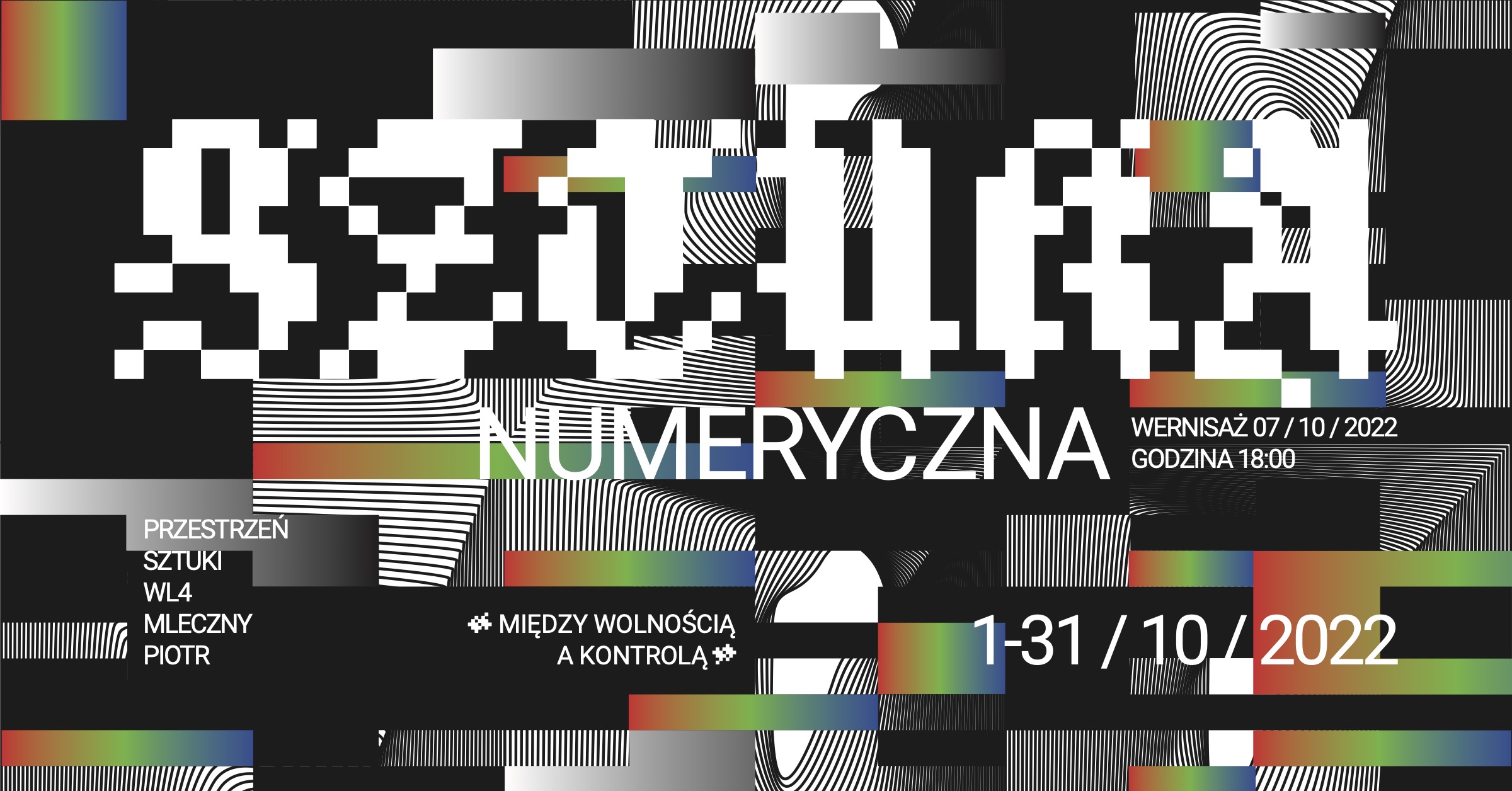
Numerical Art 2022
NUMERICAL ART – BETWEEN FREEDOM AND CONTROL
International art and research project
Project co-financed by the City of Gdańsk and supported by the Gdańsk Foundation for Economic Development.
opening: Oct. 7, 2022, 6:00 p.m.
exhibition open: Oct. 1-31, 2022
location: Art Space WL4, Mleczny Piotr
date: 11-15.10.2022
location: PATIO and Auditorium of the Academy of Fine Arts in Gdańsk
Event plan – download (18 KB) docx
Code as surveillance – go to the page
Materiality of code – go to the page
Neohybridization - go to page
Digital illusions and utopias - go to page
Theorists: Sidey Myoo, Maciej Ożóg, Piotr Celiński, Agnieszka Wolny-Hamkało
Szczecin: Zbigniew Romańczuk, Aleksandra Łukaszewicz, Radek Nagay, Andreas Guskos, Arkadiusz Marcinkowski
Poznań: Andrzej Banachowicz, Katarzyna Kujawska-Murphy, Filip Wierzbicki-Nowak
Orléans, France: Lionel Broye, Emmanuel Guez, Caroline Zand, Gaël Goutard, Nicolas Tilly, Hugo du Roure, Rafał Borkowski, Amélie Samson
Białystok, Poland: Paweł Dudko
Wrocław, Poland: Agnieszka Wolny-Hamkało and Kamil Kawalec, Bartosz Konieczny
Gdansk: Filip Ignatowicz, Robert Kaja, Robert Turło, Piotr Wyrzykowski, Małgorzata Sarnecka, Tomasz Skórka, Adam Przybysz
The exhibition “Numerical Tools – Between Freedom and Control” focused on the technological and cultural conditions of digital culture, possible scenarios for the development of visual culture, and the convergence of previous creative experiences, mainly at the intersection of culture, art, and science. The exhibition was intended to have a cognitive element and was also related to the presentation of new ways of exploring technological products and their applications in artistic practices, references to the technological infrastructure of connections in the human environment. The involvement in constructing an “artificial” reality, crossing the border between the real and virtual world, was accompanied by the fear that this action may turn against us.
Zbigniew Romańczuk
Numerical tools – between freedom and control
In the eighties and nineties, digital art resembled Gothic art: numerical tools, the language of software, coding, HTML, and graphic programs were known only to the initiated. During their seances, they produced armies of ghosts that spoke to each other during video art and net art exhibitions, and overlapping voices, holograms, and glows of screens created a specific universe: a new exhibition environment. It was difficult not to succumb to moist media, uncanniness (the uncanny: a feeling resulting from cognitive confusion in connection with contact with an object or phenomenon having the characteristics of something alien/uncanny and the characteristics of the known), performative Turing tests. The disputes about the democratization of art and distinctions came to an end. Finally, the joy and responsibility of (co-)creation were transferred to the viewer/user, who from then on was called a viewer.
Inclusiveness was no longer just a metaphor. Art from this area literally became interactive, not like op-art or sculpture in urban space: interfaces really did include us in this holo-world, which did not even have to promise futuristic utopias: it was exciting enough in itself, and the pleasure of (co-)creating was more seductive than any loyalty program or well-written game. Some exhibitions of numerical art were like ghost castles, full of electrifying attractions and funfairs where the ghosts and the skeletons sometimes even touched us. Soon, however, this holo-world full of freedom and fun became inflated, easily (as always) captured by capitalism, and the frightened ghosts had to move elsewhere, for example, to the theater, where VR, live backstage broadcasts, drones, and video performances have become popular elements of modern performance.
Meanwhile, postmodernism associated with post-Fordist capitalism was slowly becoming history, and philosophers were once again trying to put a (some) world back together from broken mirrors. The collapse of grand narratives became nothing more than a figure of speech, and a trivial and barren one at that. And the fictional and erotic journeys to the world of utopia have turned into biotechnological experiments, which have become the answer to the new great narrative: the Anthropocene, the Capitalocene, or the Anthropo-shadow, which has really cast a shadow on the imagination of several generations at the same time. The new narrative raises other problems (ecological, moral, economic, technological) and questions that we are trying to answer today. Numerical art has also taken them up, taking over ecological fears and anger at those who use digital tools not to create the common good, but to manipulate, influence, control, and exploit. At the same time, there is a strong current among researchers that points to technology as the only effective ally in restoring ecological balance on our battered blue Planet. However, most activists believe that it is technology that is to blame for the catastrophe and that numerical tools will always be nothing more than a weapon in the hands of the richest.
How has numerical art changed over the last twenty or thirty years? And who is its audience/user today? Are digital environments post-industrial farms for breeding electric zombies that track our every move online? How does computer art engage with the problems of the modern world? Maybe we know?
Agnieszka Wolny-Hamkało
“[C]omputer-mediated networks, in my view, offer the possibility of a kind of planetary conviviality and creativity that no other means of communication has been able to achieve. One reason may be that networking puts you, in a sense, out of body, linking your mind into a kind of timeless sea. It is a more precise condition that Jung describes in proposing a collective unconscious, and that is because it deals with more than feeling – with particular ideas and associations, too. These ideas, being generated from a diversity of scattered locations, set in widely different cultural contexts and channeled, of course, through uniquely different individuals, may become densely layered in meaning and implication. Networking produces an interweaving of imaginations that gives the term <associative thinking> the most amplified interpretation"[1].
According to Ascott, the new form of discourse emerging from the network of computer-mediated connections, creating a new form of consciousness, has a chance to transcend the limitations and control of traditional forms of power. Nevertheless, Ascott was already certain in the 1980s that the Internet would become the object of interest of institutions of surveillance and control, which could limit it, although they could not destroy its emancipatory potential.
The realization that power and control can be extended into the internet space, while not yet apocalyptic, can be found in the nuanced perspective of Slavoj Žižek. Žižek recognizes different types of subject-to-law relationships in the internet space, such as the suspension of the master function or its performance. In his opinion, there is no complete freedom on the web because it also functions as an “oedipal structure of the Third Order, which, thanks to its ability to mediate, sustains the subject's desire, while acting as a factor of Prohibition, preventing the direct and full satisfaction of his desire. As a result of the interfering Third Order, any partial satisfaction is stigmatized with the emphatic “this is not IT”[2].
The current form of the transformation of the form of law and power is aptly described in Gilles Deleuze's short essay Postscript on the Societies of Control[3]. The current form is based on remote control enforcing discipline, rather than on forms of external coercion and discipline. We are remotely captured, our histories and our data are collected and processed, and our every step, crossing the street on a red light and receiving a ticket is recorded in our digital history, where we are already starting to collect points. Just like in China, where the Social Credit System deducts points for not paying a bill on time or running a red light, and adds points for recycling and charity work.
What position should art take in the face of these changes?
The fascination with the possibilities offered by the internet, expressed in the net.art of the 1990s, is now part of media history and can be referred to in terms of nostalgia and low-fi aesthetics. Post-Internet art, which is an expression of an awareness shaped by the presence and participation in the Internet, does not necessarily have to take only a digital form, also turning back to the object, although it does not give up on digitality. Interactive and telematic art, digital painting, digital photography, and video art, as well as art using biotechnology, participatory art (using media at least in the preparation and distribution of the results of the work), and art critical of digital control and surveillance tools (using cameras, scanners, antennas, etc.) – all these trends in contemporary art relate to the electronic layer of reality through the use of digital tools, i.e. numerical tools.
The physical layer of reality has not disappeared, but it has lost its exclusivity in occupying our field of perception and has ceased to be the only material of the creative tools used. Programs and algorithms are electronic entities that are now frequently used as creative tools and numerical tools. However, operating numerical tools also requires hardware, a physical substrate, to which the operations performed are irreducible. For this reason, we can talk about the hybrid nature of contemporary reality in developed countries, which has physical and electronic layers that interact and interpenetrate. Art using numerical tools should define its place in a hybrid environment, without illusions about the possibility of complete freedom, but aware of its own potential.
Aleksandra Łukaszewicz
[1] R. Ascott, Telematic Embrace. Visionary Theories of Art, Technology, and Consciousness, E. A. Shanken, University of California Press, Berkeley, Los Angeles, London 2007, p. 187.
[2] S. Žižek, The Burden of Fantasy, trans. A. Chmielewski, Wydawnictwo Uniwersytetu Wrocławskiego, Wrocław 2001, pp. 243-244.
[3] G. Deleuze, Postscript on the Societies of Control, in: the same, Negotiations 1972-1990, transl. M. Herrer, Wydawnictwo Naukowe Dolnośląskiej Szkoły Wyższej Edukacji TWP, Wrocław 2007.
Adriana Majdzińska – project coordinator
Izabela and Rafał Borkowscy – project concept
sztukamumeryczna@asp.gda.pl
Code as surveillance
theory:
Dr. Maciej Ożóg
Department of New Media and Digital Culture
University of Łódź
Body and code. How algorithms change surveillance and control practices.
Studies on surveillance are based on two, often opposed, foundations: Michel Foucault's vision of a disciplinary society in which constant physical normalizing training and surveillance play a key role, as illustrated by the figure of the omnipresent Panopticon, and Gilles Deleuze's concept of a society of control, where digitization, which dematerializes all manifestations and aspects of the world, comes to the fore, while the ever-changing control is carried out by increasingly powerful tools for collecting/processing/creating data. It would seem that in the era of big data, algorithms, and Artificial Intelligence learning at a fascinatingly/frighteningly non-human pace, it is precisely the Deleuzian proposition that is a more adequate matrix for describing and analyzing contemporary surveillance and control culture. However, does the dichotomous perception of the material body and the digital shadow stand up to confrontation with the praxis of algorithmic surveillance? In an attempt to avoid a simple, not to say crude, dualism of matter and code, I tried to present arguments for the thesis that the most characteristic feature of surveillance and control in the 21st century is the hybridization of matter and code, which manifests itself at the level of tools and mechanisms, but also in practical effects and consequences for the understanding of the world and the practice of everyday life.
Cultural theorist, sound artist, curator, and DJ.
His research interests include interactive art, tactical media, bio art, network society, surveillance studies, and posthumanism. He has published numerous articles on the aesthetics of new media art, the history and theory of avant-garde film, video art, and experimental music. His book “Life in a Silicon Cage. New Media Art as a Critical Analysis of Digital Surveillance Practices” was published in 2018 by the University of Lodz Press.
Since the early nineties, he has been involved in the development of experimental music in Poland. Founder and co-creator of many bands and projects (Spear, Ben Zen, Nonstate, Aural Treat, Sub Spa, Quantum Vacuum Oscillator, i.a.). Currently, he is pursuing a solo career creating multimedia performances, audiovisual interactive installations, and videos. He uses unique prototype electronic devices, and analog and digital instruments. He also performs as Moist Hardware.
As a curator, he has organized and co-organized numerous concerts and exhibitions, including the Perform_Tech 2017 program at the Art Factory in Łódź, the L'tronica Festival of Electronic Music and New Media in Łódź, the Art._Search 2017 program in Gliwice, the “Karkowski re:mix” program 2018 (Berlin, Tokyo, Nantes, New York, Dresden), the “Beyond the Horizon” program (around 40 events between 2004 and 2009) dedicated to experimental music and audio-visual arts, 4 editions of the multimedia art exhibition “Die Kunst Ist Toth”, concerts by, among others: Coil, Noise Makers Fifes, Column One, Troum, Xaviere Charles, Z'ev, Zbigniew Karkowski, Aube, Tetsuo Furudate, Asmus Tietchens, Kasper T. Toeplitz, Marco Donnarumma, Thomas Ankersmit, Julien Ottavi, Ryan Jordan, Gil Kuno and many others. From 1998 to 2002, he ran the Ignis Projekt record label, which was dedicated to various types of electronic experimentation. Ignis released albums by artists such as Francisco Lopez, Ultra Milkmaids, Vance Orchestra, Indra Karmuka, Crawl Unit, Origami Arktika, Chaos As Shelter, EA and Spear.
art:
Aleksandra Łukaszewicz / Radek Nagay
The Rose installation combined elements of culture and technology to create a surreal environment in which known physical laws are questioned. Upon entering the raw canvas tent, which resembled an oversized ceremonial towel, the viewer was embraced on both sides by an animation that created a new, virtual space. Shapes emerged from the chaos of digital code, forming traditional Slavic patterns symbolizing the Love Song, the Sun, the Earth, the Union of the Sun, and the Earth, the Parenting Mother with the Sacred Tree. An animation of the code from The Matrix emerged in the form of a projection on a linen suspended in the form of a towel hanging at a height of about 2.50 meters from the center. The pattern of selected embroideries from the Belarusian cross-stitch, which is a cultural code that framed human life, and accompanied it at important moments on ritual towels, emerged in the form of an animation from the image of the code in The Matrix. A cross-stitch pattern was visible at the edges of the linen stretched across the floor. By darkening the room, the installation took on the form of an inverted flower illuminated from within. The installation was accompanied by sound, the song “Rose” recorded by the Wesnowewla singing group.
The work was intended to address a specific culture, in this case Slavic, as one that provides a certain order, support and beauty, while at the same time clearly defining and controlling human life, indicating that culture can be perceived like a beautiful flower, but one can also “enter its center” in order to experience it from a different perspective, more holistic, encompassing.
The work also includes an individual trademark related to experiences of the Covid-19 pandemic. In times dominated by digitality, I became aware of the closeness of Slavic culture. The pattern that was visible on the fabric appeared to me in the digital Matrix.
Authors: Aleksandra Łukaszewicz, Radosław Nagay
Singers: Sonia Mrzygołocka-Pyć, Alicja Piotrowska, Agnieszka Pawłowska, Aleksandra Łukaszewicz (from the Wesnowewla singing group)
Technical support: Anna Gregorczyk (embroidery) and Adam Sołtysik (recording and mastering) from the Center for Creative Industries of the Academy of Art in Szczecin, Anna Baczyńska and Antonio Łukaszewicz Alcaraz (construction techniques).
Emmanuel Guez
Nicolas Tilly
Nicolas Tilly has been teaching since 2013 (courses and research program) at the École Supérieure d'Art et Design d'Orléans. He also gives workshops in other art schools in France and abroad and participates in diploma juries. Nicolas approaches digital design through many media (publishing, web, video games, prototyping...) and he is interested in new ways of thinking about the before and after of publishing processes through multi-media publications. For the past two years, Nicolas has been developing a collaborative project to create interactive playing cards through a website called Cards & Coding.
Description of the work displayed at the exhibition
The four NFT playing cards are the result of a graphic research around the format and manipulation of playing cards. Initially, the cards are coded to be drawn by a plotter, then the code is reused to be animated and interactive. These cards are part of the Cards & Coding project.
Links to websites or resources
https://cards-and-coding.click/
Rafał Borkowski
His artistic research focuses on the issues of identity, time, and change.
After a series of terrorist attacks in open public spaces in France, the authorities in many cities decided to strengthen public security. One of these measures was to improve city surveillance cameras. Technological developments allow for the expansion of algorithms that can recognize a person in a crowd, not only based on the face but also on the silhouette or movement. In the opinion of the authorities, this clearly strengthens the sense of security, but on the other hand, it creates the possibility of full control of society. In the installation “vidéosurveillance”, in addition to the control aspect itself, I addressed the issue of time. Perceived in real space as past, present, and future time, and virtual space and time where the generally known order can be subject to change and in the context of the “database machine” itself takes on a new meaning. Virtual time, which only takes into account events occurring in the system, is only an approximation of synchronous real-time.
Professor at the Higher School of Art in Orleans, France. Teaches drawing and drawing concepts. He develops international cooperation with art academies in Poland (Gdańsk, Wrocław, Warsaw). Initiator and organizer of many Polish-French exhibitions and cultural projects.
Materiality of code
theory:
Piotr Celiński
Digital culture promised its sympathizers and followers that the difference between matter, i.e. nature, and information, i.e. culture, would cease to matter thanks to its development. This is one of the founding myths of digital culture, and its realization forces us to ask questions about the cultural reach of digital media, the politics of its use, and possible alternatives to this state of affairs. Staring at the colorful screens of digital worlds, with our ears blocked by earphones, we do not pay enough attention to the fact that by bypassing our field of vision and hearing and the other senses and organs, digital media and their programs effectively and with momentum get under our skin and settle in our organs, tissues and neuronal structures for good. Bits colonize atoms and codes materialize in the tissues of our bodies – this is the point of reference I adopted for a brief reconnaissance of the space of media theory, digital art, and cultural anthropology.
Piotr Celiński – media scientist, professor at the Department of Media Theory at the Maria Curie-Skłodowska University in Lublin. He deals with new media, the Internet, digital culture, social communication, and visual and popular culture. Co-founder and board member of the “Institute of Digital Culture” Foundation, co-creator of cultural events, exhibitions, and educational activities (Mindware; EPCC), deputy director of the Video Game Research Center UMCS in 2015-18.
art:
Andrzej Banachowicz
I combine and permeate culture – and even history – through tradition and modernity in my work. Inspired by a long-standing and broadly understood survey, I merge communication with digital technology. Having worked for years in the techniques of handicrafts, hand-weaving very large areas of living matter, I am now transforming them into objects of expression in a new code of materiality. It opens up new visual fields of creation for me in a new perspective. With this new experience, the conceptual record acquires qualities that work with a sophisticated, permeable aura of a new image, created from digital photographic reproductions, in a conceptual invention characterized by the strong materiality of the previously hand-created structure. Currently, these contextual new works, in a kind of dematerialization, deepen the symbolic and metaphorical potential of the “quoted” prototypes. The matte material of the weaving raw material now becomes a luminous reproduction of old weaving structures. Such a creative transformation, or rather the dematerialization of weaving installations, gains greater reflectivity and a more or less comprehensible spirituality encoded in it. By using the visual self-quotation technique, I not only quote the details but also document them as if anew. I create from them now shiny materiality, additional new artistic situations. This is the potential of a strictly defined method of action, where specially selected fragments from weaving compositions currently in the digital environment and after appropriate processing on aluminum type dibond – photo print – become the basis for new artistic concepts. Images emanate a specific glow, which can be intensified by using appropriate external lighting. This new creative object – like an archetype of existence – is somewhat reminiscent of a painting but also reveals clear differences from the pictorial art object. It reflects light differently, has no texture, and can be both cool and sensual in its purely visual impact. It can also activate the potential of the “documentary” dimension of photography without depriving it of its original, credible materiality. It becomes a kind of contemporary, neo-traditional message with creative respect for the heritage of ancient culture and the current achievements of human civilization. Valuable art of the past, permeating the present, eliminates the current boundaries between past and future time. Penetrating through all these layers, I impose on them what is new and ambiguous, which is most worthy of our – my – cognition. I listen in silence in a state of keen attention contained in the eponymous “materiality” of the code.
Andrzej Banachowicz – Wikipedia, the free encyclopedia
Paweł Dudko
Dr. Paweł Dudko (born 1987) is an active creator in the field of interactive and generative art using spatial printing, often on the borderline between physical and virtual space. He is the author of spatial installations, multimedia, photography, and scenography.
He graduated in architecture from the Faculty of Architecture at the Białystok University of Technology. In 2018, he obtained a doctorate in art from the Faculty of Sculpture and Intermedia at the Academy of Fine Arts in Gdańsk. In the years 2012-22, he was a research and teaching assistant at the Faculty of Architecture at the Białystok University of Technology.
He has presented his works in many galleries in Poland and abroad, including XX1 (Warsaw), Musée du Jouet (Moirans-en-Montagne, France), Yanaki Manasiev Gallery (Veliko Tarnovo, Bulgaria), Contemporary Art Gallery miejsce sztuki44 (Świnoujście) and at many reviews and festivals, including: Dizaino Savaitė (Vilnius, Lithuania), Contested Cities (Madrid, Spain), FAMA International Art Campus (Świnoujście).
Recipient of scholarships from the Mayor of Białystok (2015) and the Minister of Culture and National Heritage (2020).
http://www.pdudko.com/2016/08/populacje-cialo-otwarte.html
Robert Kaja
Prof. Dr. Hab. Robert Kaja, works at the Academy of Fine Arts in Gdańsk, in 1992 he obtained a diploma in the studio of Prof. Franciszek Duszeńko. Long-time assistant to Prof. Zdzisław Pidek. Since 2004, he has been running the Space Design and Organization studio at the Faculty of Sculpture and Intermedia at the Academy of Fine Arts in Gdańsk. Head of the Department of Specialization in the Sculpture Department. Organizer of workshops and conferences on the relationship between sculpture and architecture, a repeated participant or organizer of open-air workshops and exhibitions at the Center of Polish Sculpture in Orońsko. Author of the winning project in the competition for the Bolesław Leśmian monument in Zamość; created also the granite outdoor sculpture “tree of life” in Aberdeen, Scotland – 1994, the monument to the Zielona Góra Events of 1960 in Zielona Góra – 2010, the Hevelius and Fahrenheit plafonds at the Gdańsk University of Technology, outdoor sculpture in granite 12=12 Strzegom – 2018. He made the statuette of the Rejtan Award for Jarosław Marek Rymkiewicz.
Exhibitions: CRP in Orońsko, Center for Contemporary Art Ujazdowski Castle in Warsaw, Łaźnia in Gdańsk, National Museum in Warsaw, Gdańsk, BWA in Katowice, Zielona Góra, Sopot, Museum of Art in Łódź and others.
Robert Kaja | Current Teachers and Current Students | Armoury of Art
Rafał Borkowski
Tomasz Skórka
At the exhibition, I presented a fragment of the “Gifts” series, spatial objects with the features of a figurative sculpture, which I created in a digital environment and printed using FDM technology. The mechanical method used to produce these objects makes them seem like trivial plastic products, technically and conceptually distant from Art. The overriding goal of my work is to find an artistically acceptable form for this type of creation. At the exhibition, I wanted to show objects representing one of the ways to overcome the triviality barrier based on deepening the aesthetic values of digital work and an attempt to look into the essence of artificial depth, which is a virtual workspace devoid of gravity.
Tomasz Skórka | Current Teachers and Current Students | Armory of Art
Neohybridism – neohybridization
theory:
Sidey Myoo
Subject: Digital-analog art
The topic of the presentation was to show the interdependence between analog and digital media and their mutual interaction using art as an example. It was about the relationship between numerical processes that are imposed on analog phenomena in the physical world, e.g. those related to temperature, light, or matter. During the presentation, examples of artistic works were shown, including the Solar Sinter Project by Markus Kaiser, Robotika, The Nannybot by Joaquin Fargas, and The Jller by Benjamin Maus, Prokop Bartoníček. The presentation was focused on encouraging further insights into the nature of consciousness, physical reality, or time by raising questions about their binary or wave nature.
Sidey Myoo – since 2007, the scientific pseudonym of Prof. Michał Ostrowicki, PhD, philosopher and art theorist. Sidey Myoo works at the Aesthetics Studio of the Institute of Philosophy at the Jagiellonian University and the Department of Media Art Theory at the Academy of Fine Arts in Krakow. His main area of interest is aesthetics, treated as art theory, mainly in relation to contemporary art, including new media art. Since 2003, he has also been dealing with network philosophy. In 2006, he used the term virtual realis (later: electronic realis), which became the basis for ontoelectronics, i.e. ontology aimed at the analysis of virtual reality, treated as a sphere of being. He is the author of the books: A Work of Art as a System, Virtual Realism. Aesthetics in the Age of Electronics, Ontoelectronics, and edited works, as well as a number of articles. He is the co-editor of the multimedia magazine Medialica. Multimedia Studies in the Humanities and the magazine Kultura i Historia. In 2007, he founded Academia Electronica, a virtual, non-institutionalized part of the Jagiellonian University operating in the electronic world of Second Life and Altspacevr, where official academic courses are conducted.
art:
by Filip Ignatowicz, PhD – AVATAR ART EXPERIENCE
lecture and premiere of a new work from the artUNBOXING series
ASP PATIO – Monday, November 28, 2022, at 3:00 p.m.
as part of the international conference and artistic research project:
NUMERICAL ART – BETWEEN FREEDOM AND CONTROL
For more information, go to
Zbigniew Romańczuk / Radek Nagay
ART IN THE POST-CYBER AGE
The main theme of our work presented at the exhibition is the interpenetration of physical and digital environments, which changes our understanding of embodiment, nature, and the social environment. Our artistic practice stems from the belief in the existential reality of these two layers of reality, which manifest themselves in a hybrid and intermedia way. By reflecting on the nature of digital reality, we reveal human traces in the mathematical logic of the digital iconosphere. Operating on physical and digital matter, we search for ways to create, read, and interpret images in changing cultural, social, and technological contexts.
The works from the Intelligent Forms Connect series are based on the examination of the relationship between analog and digital techniques, photography, photobashing, 2D and 3D generative art, computer simulation techniques, and computer modeling. The works present a kind of “screen space” referring to the dichotomy between the traditional painting space and the virtual space of the computer. The analog photos were scanned, then digitally processed, printed on film, and photographed again in a modified configuration. The resulting digital files were then superimposed as textures on the digitally generated surface. Printed on canvas, the layered works with complex visual structures maintain a balance between process and determinism, strategy and experiment.
Radek Nagay
Graduated in Biomedical Engineering at the Faculty of Electrical Engineering, West Pomeranian University of Technology in Szczecin, assistant at the Faculty of Design, Academy of Art in Szczecin, PhD student at the Academy of Fine Arts in Łódź. Head of the Virtual Design Laboratory at the Center for Creative Industries in Szczecin. Designer with over 20 years of experience in the field of visual communication. Passionate about mathematics and theoretical physics. His achievements include several hundred commercial graphic and multimedia projects and over a dozen interactive installations at the intersection of art and new technologies.
Zbigniew Romańczuk
Dean of the Painting Department at the Academy of Art in Szczecin. In the years 2010-2016, Vice-Rector for Art and Science at the Academy of Art in Szczecin. In 2018, he was awarded the title of professor of fine arts. In 1993–1994, he was a scholarship holder at the Royal Danish Academy of Fine Arts in Copenhagen.
In the years 2010-2017, he carried out an artistic and scientific project called Grid, a system that addresses the issue of the image in the era of the development of techniques for the reproduction, processing, and creation of images leading to their hybridization. The resulting works were based on a digital record defining the pixel structure of the image, the configuration of geometric elements with strong optical effects, and dense modular structures, subordinated to the discipline of rhythm. Subsequent exhibitions in this series showed the technological and cultural determinants of artistic concepts, and referred to possible scenarios for the development of visual culture and to the problem of the autonomy of the image and the self-referentiality of its message.
Works from this series were presented, among others, at the following exhibitions:
– Edited Images, National Museum, Szczecin, 2013
– Geometry of Color, BWA Gallery, Municipal Art Center, Gorzów Wielkopolski, 2013
http://www.mosart.pl/galeriabwa-archiwum-2013/detail,nID,4554
- Pictorial space, Galeria Kierat ZPAP, Szczecin, 2013
http://www.zpap.szczecin.pl/wystawy/zbigniew_romanczuk_pictorial_space.htm
- Spatial screens, Galeria Schloss Bröllin, International art research location (DE), 2013
- Visual Representations, Lubuskie Museum, Gorzów Wielkopolski, 2014
- Hidden Energies, Kierat Gallery of the Association of Polish Artists and Designers, Szczecin, 2014
- Singularity of the Image I, Gallery of the Association of Polish Artists and Designers, Gdańsk, 2014
- Grid System I, Scena Gallery, Baltic Gallery of Art, Koszalin, 2015
Grid System II, Baltic Art Gallery, Słupsk 2015
https://bgsw.pl/portfolio/zbigniew-romanczuk-grid-system/
Singularity of picture, MS Gallery, Wakayama (JP), 2015
Moving pictures, Galeria Profil CKZ, Poznań, 2016
http://www.artluk.com/eart.php?id=68
https://ckzamek.pl/wydarzenia/914-moving-pictures-zbigniew-romanczuk/
– Geometry of the screen – geometry of the image, Galeria El Art Center, Elbląg 2016
– 5th International Digital Graphics Biennale, Design Center Gallery, Gdynia 2016
- XXV Festival of Polish Contemporary Painting, Szczecin 2016
- Digital code image, Gallery of the Gdańsk Society of Friends of the Arts, Gdańsk, 2016
- Second Sight, XS Gallery, Institute of Fine Arts, Kielce, 2017
– Digital Paintings, Rondo Sztuki Gallery, Katowice, 2017
http://www.rondosztuki.pl/wydarzenie.php?id=706
- Concrete/Discourse/Algorithm, University Gallery, Cieszyn, 2018
- Concrete/Discourse/Code, EL Gallery, Elbląg, 2018
- Concrete/Discourse/Complexity, XS Gallery, Kielce, 2018
- Mediations Biennale, Raczyński Museum, Poznań, 2018
- International Art. Exhibition, Sakai City, (JP), 2018
- Digital born, Koridor Gallery, Ostrava, (Czech Republic), 2018
- A – 21, Nika Gallery, Osaka, (Japan), 2019
- Art. Pozy +, Duża Scena Gallery, Poznań, 2019
- 6th International Digital Graphics Triennial, Gdynia 2019
- Masks, BWA Gallery Ostrowiec Świętokrzyski, 2020
http://bwa.ostrowiec.pl/covimetry/
- Hyperlink, National Museum, Szczecin, 2020
- Hyperlink – new image of the world and the human, National Museum, Szczecin, 2020
https://playcanv.as/p/30ckJX6f/
- What will each person come up with about themselves, Trafostacja Sztuki, Szczecin, 2021
- Covimetry international exhibition, Ely Center of Contemporary Art., New Haven,
Connecticut USA, 2021
The works shown in the Grid system series have become a contribution to the theoretical reflection by the authors of the monograph New Fields of Imaging – Digital Painting on the Example of “Grid System” by Zbigniew Romańczuk
The publication was released by the Academic Publishing House of the Academy of Art in Szczecin in 2016, edited by Ryszard Ziarkiewicz and Joanna Szczepanik, PhD, and reviewed by Prof. Piotr Zawojski.
Scientific publications and contributions to collective works:
https://www.academia.edu/40928195/Widzialno%C5%9B%C4%87_wizualno%C5%9B%C4%87_obrazu_cyfrowego_Pomi%C4%99dzy_fenomenologi%C4%85_a_kultur%C4%85_wizualn%C4%85_red_A_%C5%81ukaszewicz_Alcaraz_2016
Artistic and academic internships:
2014 – Visiting Professor, Department of Fine Art, Muthesius Kunsthochschule, Kiel, Germany, lecture: Screen as a symptom of contemporary visual culture,
2015 – Visiting Professor, Department of Fine Art, University of Lisbon, Lisbon, Portugal, lecture: Emancipation of a technical picture,
2016 – Visiting Professor, University of Ostrava, Faculty of Fine Arts, Czech Republic, lecture Singularity of picture, – Conducting art workshops Interaction of space and color with students of the Department of Painting of Prof. František Kowolowski
2016 – Invited by Prof. Liv Hausken to participate in The International Symposium on Media Innovations at the University of Oslo. The symposium focused on post-humanism and research methodology.
2018 – Visiting Professor, University of Ostrava, Faculty of Fine Arts, Czech Republic, lecture: Digital born
Film by Zbigniew Romańczuk – go to website
Arkadiusz Marcinkowski
Series: “Palindromic numbers ”
Graphics / Digital art video
101 100111001 110111011 111010111 1100011100011 1110110110111 1110111110111 101000010000101 10111000 0011101 111100111001111 10000010101000001 10111000000011101 10111101110111101 10111110101111101 1011 111110111111101 100001111111111100001 100011111010111110001 100111111111111111001 101000000010000000 101 110000000010000000011 110000011111110000011 111000011111110000111 111101101111101101111 11111000 0111000011111 111110101111101011111 111111110111011111111 10000100000100000100001 100001111110111111 00001 10011111111111111111001 10110111111111111101101 11000000001110000000011 1110000001111100000011 1 11111100000100000111111 11111111000100011111111 11111111100100111111111 11111111111111111111111 10 000000111000000011100000001 10001111000111111100011110001 10001111111111011111111110001 100111111000 00000000111111001 10111111111101110111111111101 11110111111101110111111101111 1111110111111101111111 0111111 11111111000000100000011111111
The work is based on sequences and algorithms of palindromic numbers. A palindromic number is a number (e.g. 16461) that remains the same when its digits are reversed, i.e. it can be read the same way from left to right as from right to left. In other words, it has reflection symmetry on the vertical axis. In the case of a palindrome, the spelling remains the same when its letters are reversed. The first 30 palindromic numbers (in decimal system) are: 0, 1, 2, 3, 4, 5, 6, 7, 8, 9, 11, 22, 33, 44, 55, 66, 77, 88, 99, 101, 111, 121, 131, 141, 151, 161, 171, 181, 191, 202, …
Palindromic prime numbers are 2, 3, 5, 7, 11, 101, 131, 151, ...
There are infinitely many palindromic numbers in any base, because in any archive, an infinite sequence of numbers written (in that base) as 101, 1001, 10001, 100001, etc. consists exclusively of palindromic numbers. This work uses palindromic prime numbers made up of zeros and ones.
Bio
Arkadiusz Marcinkowski was born in 1970 in Poland. In 1989, he graduated from the Secondary School of Fine Arts in Szczecin. In 1991, he began studying at the Academy of Fine Arts in Poznań. He studied in the Netherlands from 1995 to 1996. In 1996, he obtained a master's degree in art from the University of the Arts in Poznań. He has organized several exhibitions of graphics and easel painting and has participated in many exhibitions abroad. Among others, to Japan, he traveled several times and had a number of exhibitions in prestigious galleries in Osaka, Tokyo, Kobe, Kyoto, Yamanakadani, Kumamoto, Wakayama, Nakanojo, Takaruzaka, Sakai, and Tamana. He is a member of the Japanese art organization A-21 operating in Osaka. In 2011, he obtained a postdoctoral degree at the University of Arts in Poznań. In 2013, he was appointed associate professor at the West Pomeranian University of Technology in Szczecin and at the WSUS in Poznań, where he holds the position of vice-rector. Currently, he is the dean of graphic design at the Academy of Art in Szczecin. In 2020, he was awarded the title of full professor by the President of the Republic of Poland. He is the author of many individual exhibitions. He has participated in several dozen group exhibitions in Poland and abroad, including in the Netherlands, Germany, Japan, Turkey, Belgium, Greece, Italy, Lithuania, Belarus, Ukraine, Hungary, Georgia, Taiwan, and Israel. in the Netherlands, Germany, Japan, Turkey, Belgium, Greece, Italy, Lithuania, Belarus, Ukraine, Hungary, Georgia, Taiwan, Israel, Russia, Spain, Portugal, Norway, Iran, China, the Czech Republic, Slovakia, the United Kingdom and many places in Poland. He works in the fields of digital graphics, also with the use of artificial intelligence, video art, graphic design, painting and spatial activities.
Lionel Broye
Gaël Goutard
Caroline Zand
Małgorzata Sarna Sarnecka
“Who's the bell for?” The work presented at the exhibition is a critical commentary on the present times. I conveyed my commentary on the present times by using the symbol and shape of a bell and the fact that it is also a carrier of information. In my work, the bell has a classic shape that the viewer knows and associates with this instrument. The bell was suspended on a frame resembling the real structures used to mount them. It was made of silicone. You could see its contemporary heart. The heart consisted of a battery, speaker, subwoofer, controller with software, and motion sensors. The bell was stationary. It generated sound using motion sensors. The paths were generated in real-time, and the sounds were distorted. In this way, I was talking about the fact that every human being leaves a trace, a digital noise. It is also a commentary on the present day, where society is flooded with a flood of information. We live in the age of anthropo-ino-noise. Our presence in the world determines our presence in the digital world. Moreover, it is not uncommon for the media to initiate 'false alarms' to control public attention. The name of the bell refers to this issue: Fake Fact, Factum Falsum.
Graduate of Sculpture at the Academy of Fine Arts in Gdańsk. Graduated from the studio of Prof. Mariusz Białecki. Graduated from the University of Rzeszów in the field of Designing Space and Sculptural Forms. Graduated from the studio of Jerzy Kierski. Graduated from the State Post-Secondary School of Culture Animators and Librarians in Krosno. Defended her diploma in the studio of Analog Photographic Techniques led by Dr. Andrzej Drozd.
Laureate of the Technological Thought competition of the Rzeszów University of Technology. Winner of the competition for the design and construction of a fountain in the Garnizon housing estate in Gdańsk. She participates in sculpture, painting and intermedia open-air workshops. She uses various technological possibilities in her work.
Digital illusions and utopias
theory:
Agnieszka Wolny-Hamkało
We had fun for a whole decade: we lost ground under our feet, looking at ourselves in cracked mirrors. The most beautiful things for us were bankrupt ideas and teams that lost. Illusions, delusions, and distortions of reality were our daily bread. Until we finally woke up too late for everything, with a terrible hangover, at the edge of the pit. Our resources have been depleted; we are exhausted. Work and addiction to illusions have robbed us of our vitality. Illusion is associated with just that: with a hall of mirrors, with seduction, with a play of images and meanings, and finally with an escape from reality. What could illusion be in a new world – in which we try to regain history and agency, engage in social change, and build a new, equal community? After all, what is important is the potential of an experimental field, a separate place for safely trying out new ways of living. Utopia, on the other hand, must lose its narcotic character and become a horizon of possibilities – a possibly/impossibly perfect spectre of the good world that we would like to build.
Poet, playwright, and author of theater plays, novels, and books for young adults. Recently, she published a volume of poetry, “Lichtenstein’s Raster” and the novel “In the footsteps of”. Author of an anthology of short stories, curator of the International Short Story Festival. Nominated for the Gdynia Literary Award for “Love’s Spams” and the Hestia Literary Journey award for the novel “Po śladach”. Winner of the IBBY award for “Lato Adeli” (Book of the Year 2019). The Polish Theater in Wrocław and the Capitol Musical Theater have staged her plays, including “Foresters. Apocrypha” and “Liberation: queens”. Editor and co-founder of the poetic and social magazine “Zakład”. PhD student at the Institute of Literary Research of the Polish Academy of Sciences. Her scientific focus is on camp in new Polish poetry. She lives in Wrocław.
Kamil Kawalec
Poet, musician, cultural organizer. Co-founder and editor of the community poetry magazine ZAKŁAD. Founder of Nieregularne Środowisko (an initiative dedicated to young poetry in Wrocław). Author of the publication Reguły gry, antologia młodej poezji wrocławskiej 2020 r. [Rules of the Game, an Anthology of Young Poetry from Wroclaw, 2020], for which he was nominated for the WARTO 2021 award. He has published in “Polski Stiner”, “Wizje”, “Malkontenci”, “Cegła”, “Kontent”, “8. Arkusz Odry” and other magazines. His book “Wieża gabba” [Gabba Tower] will be published soon. He lives in Wrocław.
Bartosz Konieczny
Graphic designer, motion designer, VJ, video artist. In his work, he combines geometric, often generative animations with minimalist video recordings. He experiments with audio reactivity, exploring the possibilities and methods of synchronizing sound with video in real-time. His hobby is acrobatics. He lives and works in Wrocław.
art:
https://wyrzykowski.weebly.com
Piotr Wyrzykowski aka Peter Style, born in 1968 in Gdańsk, is an artist, performer, and set designer.
He graduated from the Intermedia Studio “Pi” of Prof. Witosław Czerwonka at the Academy of Fine Arts in Gdańsk, where he currently works as a lecturer at the Faculty of Painting.
He is the creator of mobile applications, videos, multimedia performances, interactive installations, internet projects, and activities in public spaces.
He made his debut as a performer in 1990 (Galeria Wyspa) by co-creating the Ziemia Mindel – Wurm duo (with M. Rogulski).
In the 1990s, he actively participated in the Gdańsk art community, engaging in activities co-creating the New Gdańsk School. He was a member of the Social Initiatives Club Association running the C-14 gallery, co-founded the Open Atelier Foundation (currently Łaźnia Centre for Contemporary Art), and was the vice-president of the Wyspa Progress Foundation.
His current activity, which uses the latest technologies to create global participatory performances, is a development of individual performances from the 1990s.
Co-founder and artistic director of the C.U.K.T. (Central Office of Technical Culture) group, which uses the Internet's reach for artistic activities in a pioneering way (Presidential Campaign of Victoria Cukt, 2001).
He is the author of the pioneering Polish Internet work (44, 1999) based on Matejko's Polish Kings' Post.
His video work (“Beta Nassau” 1993) is part of the collection of the Museum of Modern Art in New York.
His works are also part of the collections and archives of MSN in Warsaw, Modern Musuem in Wrocław, Art Museum in Łódź, NOMUS in Gdańsk, CSW Zamek and the private collection of the Pinchuk Center in Kiev.
Robert Turło
Works Core and Cage
They were realized in 2022.
Technically, they were based on the classic phenomenon called “pepper ghost”.
The illusory nature of the reflection in the glass is complemented by the illusion of animation technique.
The result is a mixture of two “realities”; the projected and the real (albeit arranged).
This effect also appears to me as a kind of “spatial mapping”.
The formal experiment encourages philosophical reflection.
Robert Turło
Director, screenwriter, animator. Author of music videos and animated films. Winner of numerous awards, including:
World Gold Medal at the New York Festivals (2005), the special prize “REMI” in Houston (2007), and a nomination for a short film for the “Palme d'Or” in Cannes (1991).
Since 2003, he has been cooperating with an animation studio in Poznań.
Since 2013, he has been programming and co-hosting the open educational workshop “Animowana Łaźnia” at the Łaźnia Center for Contemporary Art in Gdańsk.
Since 2016, he has been running the Animation and Visualization Activities Studio at the Graphics Department of the Academy of Fine Arts in Gdańsk. In addition to the experience of film animation, a lot of attention is paid to the search for unusual forms of projection of animation and film materials.
The exploration of old and new ideas of presenting moving images goes beyond the traditional way of presenting them (standard screen).
Unusual materials and objects, as well as the nature and phenomena of the surrounding reality, such as wind, water, and space, become elements of dynamic graphic activities.
They bring in the natural aspect of unpredictable generativity.
Robert Turło – Life and work | Artist | Culture.pl
"The brain – interpreted as a human and his/her memory.”
Mental states as a product of the brain, are considered as possibilities of visual communication, which is ultimately what the purpose of a physical object should become.
A process that introduces the eternal dilemma of the mind-body and body-soul problem. Mental states are attributed not only to the brain structure but also to artificial intelligence.
Qualia in visual art – connections to the psychophysiology of vision.
Since it has become clear that audible and visible waves are the same type of wave, released as a result of the movement of quanta in atoms, it is theoretically possible to build objects from urban pollution with noise generated by highways, airports, train stations, and all construction work. In theory, it is possible to transform noise into electricity – into batteries or light.
Noise is inscribed in the human psyche, as absolute silence leads to hallucinations and pain, and volunteers testing the quietest place on Earth – in a laboratory in Orfield, USA – only lasted 45 minutes in such a chamber. Similarly, the defense mechanisms of the human psyche and the tools of artistic expression are inscribed in the health of the human species.
The human brain's adaptation to noise is the result of evolution.
BIO
The main field of Katarzyna Kujawska-Murphy's artistic research is space and time in the context of the psychophysiology of perception. This is visualized in into-spatial installations. The artist also explores the social aspects of human existence in the psychology of the city. Her work is characterized by the aesthetics of modernism and constructivism, as well as the video art of the 60s and 70s.
Katarzyna Kujawska-Murphy is a graduate of two art academies:
Central Saint Martin's College of Art and Design in London and the Academy of Fine Arts in Poznań (now the M. Abakanowicz University of Arts), where she is the head of the 1st Department of Drawing and teaches at the Faculty of Painting and Drawing.
In 2010, she received a state award:
“Meritorious for Polish Culture”. She is a laureate of the Minister of Culture and Art Award (National Painting Review, Promotions'97, Legnica – Best Diploma).
She has participated as a speaker in international symposia, including at Columbia University and the School of Visual Arts in New York, where she made a project and exhibition in cooperation with the Kosciuszko Foundation: “Slow Motion Silence” at the Lou Reed Studio in Westbeth.
She exhibits in Poland and abroad, mainly in England, Japan, South Korea, Germany (including BAUHAUS School-Dessau), Italy, the USA, Ukraine, and Taiwan. She is a curator of international exhibitions, including Regeneration of Forgotten Districts of Poznań, art festivals in cooperation with centers in London, Berlin, and Osaka. For 20 years, she has been promoting Polish contemporary art abroad, mainly in Japan.
Filip Wierzbicki-Nowak
My field of research relates to utopian visions of reality, but also to the forecasts that accompany their emergence. By examining the linguistic codes of digital images, I try to use them to perceive the illusions of contemporary civilizational values. It is also an attempt to face the challenges that await us in the near future. It is a look at ourselves and a qu